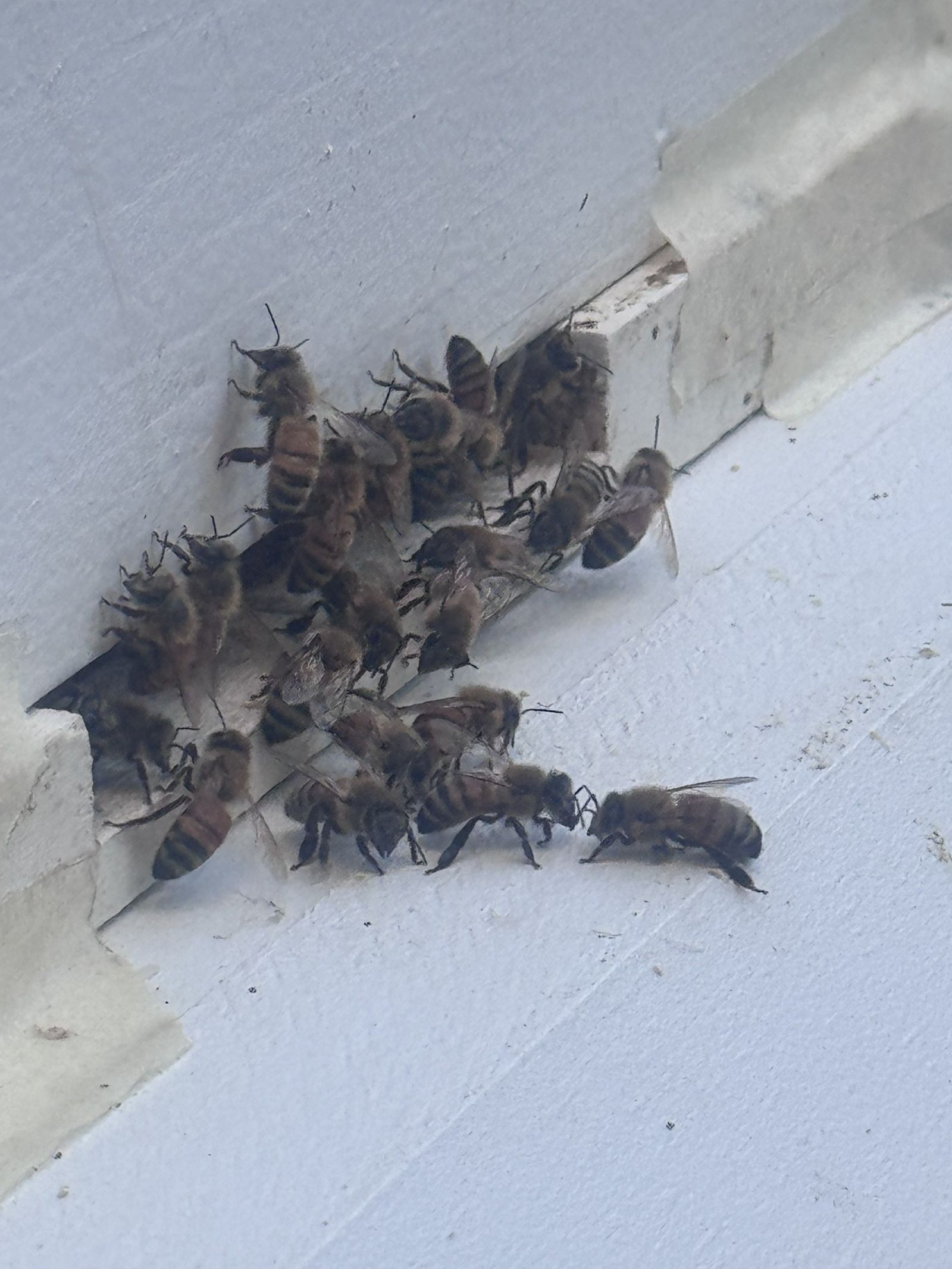
December is the quietest month in the bee yard, and that's the trap. The bees aren't doing much you can see, so it's easy to leave them alone until the first warm day in February. But a lot of what decides whether a colony makes it to spring gets settled right now: how many mites are riding along, how much food is left, and whether anything is getting into the box that shouldn't be.
This is the first of a monthly series for beekeepers here in Northeast Alabama and the rest of USDA Zone 8a. I'm not an expert. I'm a beekeeper who reads the research so I can make better calls in my own yard, and I'd rather show you where the advice comes from than ask you to take my word for it. Every claim below has a numbered source at the bottom so you can check me.
Going into winter, our yard is one colony: Sawyer's Hive, a single deep box that went through a hard reset in August. It's sealed up to be as wind-proof as we can make it, and the mouse guard is on.
Almost everything else this month depends on whether your colony has capped brood. Up north, colonies settle into a long, predictable broodless stretch. Auburn's Bee Center, which is tracking winter brood across the country, points out that this may not be the case for colonies in southern regions with mild winters 2. Mississippi State's extension guide says queens in the Deep South start laying again in early January 3. So if our colonies get a broodless window at all, it's short, and it may be right now.
Here's why that matters. Oxalic acid, the main winter mite treatment, can't get through wax cappings to the mites breeding underneath 4. Treat a colony with no capped brood and nearly every mite in the hive is out in the open. Treat one with capped brood and a lot of them ride it out.
Checking is quick. Auburn's method takes two or three minutes a hive 2:
Then close it up. You're not doing a full inspection in December. You're answering one question.
The Honey Bee Health Coalition's Tools for Varroa Management, now in its 9th edition (June 2026), is the reference I go by for mite numbers. It uses two levels: either you don't need to treat yet, or you treat promptly 1.
| Colony phase | No treatment needed yet | Treat promptly |
|---|---|---|
| Dormant (winter, where we are now) | Under 1% | 1% or higher |
| Population increase (spring buildup) | Under 1% | 1% or higher |
| Peak population | Under 2% | 2% or higher |
| Population decrease (late summer, fall) | Under 2% | 2% or higher |
Mites per 100 adult bees. Source: HBHC 9th edition, Table 1 1.
The percentage is mites counted, divided by bees sampled, times 100. HBHC's standard sample is about 300 adult bees, roughly half a cup, taken from brood-nest combs, and it says fewer than 300 won't give you an accurate number. It also rates an alcohol or soap wash as more reliable than a powdered sugar shake 1. On a 300-bee sample, 1% is just three mites. That's how low the winter bar is.
Two more things from the guide that matter this month. First, sampling during dormancy is less important than in other seasons because mite reproduction slows down, and the key sample is the one taken just before the colony clusters. If you do sample in winter, wait for milder weather 1. Second, if you have fewer than ten colonies, sample every one, and if you can't, treat the whole yard when any sampled colony is over the threshold 1.
So here's how I read it for December. If your last wash after your fall treatment came in under 1%, you don't need to break open a cluster to wash again. If it came in at 1% or higher, or you never washed after treating, plan an oxalic acid treatment for the broodless window.
A broodless colony is the best shot you'll get all year. HBHC lists oxalic acid dribble or vapor as a best option in the dormant phase, with 82 to 99% efficacy when no brood is present 1. When brood is present, it takes several applications over multiple weeks to catch the mites as they come out of the cells 4.
Use a product registered for use in beehives, such as Api-Bioxal or EZ-OX, and follow its EPA-approved label. Washington State and University of Florida researchers are blunt about it: label adherence is required, and they warn against unregistered products 4. The label on the package in your hand is the one that counts. If anything below differs from it, go by the label.
For the powder products, the HBHC guide lists 35 grams mixed into 1 liter of 1:1 sugar syrup, 5 mL trickled into each bee space that has bees in it, up to 50 mL per colony 1. Dribbling means opening the hive, so save it for a mild day, and know that a tight cluster can make it less effective 1.
For Api-Bioxal, the 9th edition lists 4 grams per brood box for the vaporizer method, following your vaporizer's directions 1. EZ-OX's label gives a different vapor dose, so use the one on your package. Don't shortchange the dose. A University of Florida study tested 1, 2 and 4 grams and found the old 1-gram rate didn't bring mites down, even with repeated treatments. The 4-gram colonies had the lowest mite levels, and the researchers saw no harm to colony health at any dose 5. The upside of vapor in winter is that you treat through the entrance without pulling frames.
HBHC calls vaporizer application "extremely dangerous to applicator health" and lists a respirator, goggles, long pants and long sleeves, with the applicator standing upwind 1. The Washington State guide calls for a NIOSH-approved particulate respirator, eye protection and chemical-resistant gloves for every oxalic acid method, dribble included 4. Check your product label for the exact respirator it requires.
HBHC says to always sample again after a treatment 1. A treatment you don't check is a guess.
Our plan is an oxalic acid vapor treatment in January.
How much honey does a colony need down here? Alabama Extension puts it at about 60 pounds, roughly one medium super's worth 6. Mississippi State says 60 to 65 pounds above the cluster in late autumn, with at least 30 pounds still there in late winter 3. For comparison, the University of Florida's guide for northern beekeepers uses about 90 pounds 7. Our colonies need less, but they don't need nothing.
You don't have to open the hive to check. Alabama Extension's method is to gently lift the back of the hive to judge how much food is left 6. Do it every few weeks and you'll learn what heavy and light feel like on your own boxes.
If it's light, feed solid sugar, not syrup. Alabama Extension says solid feed is the choice when temperatures are below 50°F, in the form of beekeeping fondant, sugar cake, mountain camp or a candy board 6. Syrup in cold weather can chill the bees, because they have to evaporate the extra water 3. Put the feed where the cluster can reach it, right above the bees, since that's where winter stores need to be 3. One more catch from Alabama Extension: baker's fondant is not the same product as beekeeping fondant and shouldn't be used 6.
Hold off on pollen patties for now. Mississippi State's beetle guide says to save pollen feeding for early spring, before beetle numbers climb, and never to give more than the bees can eat in two days 10.
We have fondant on Sawyer's Hive now because this colony went through that hard reset.
A winter cluster makes heat and moisture, and that moisture has to go somewhere. The University of Florida's overwintering guide puts the goal simply: hives must be sheltered from the wind but still have enough airflow to discourage moisture building up inside 7.
Walk your yard and look at it from the bees' side. Is a north wind hitting the entrance straight on? Is water standing anywhere on or around the hive? Is the top sealed so tight that damp air has nowhere to go? None of that takes a hive inspection to fix.
Ours is sealed up to be as wind-proof as we can make it, with a sawdust quilt over the inner cover to deal with moisture.
Mice want what your hive has in winter: warmth and shelter. University of Nebraska researchers note that as the cluster moves up through the winter, mice can nest underneath it, disturb the bees and spoil the stores. They also point out that a regular wooden entrance reducer can be pushed out of place by mice, which is why metal guards go on when you winterize in late fall 8. If yours isn't on yet, put it on now.
Adult small hive beetles can survive the winter inside the cluster with your bees 9. A winter cluster is smaller and covers less comb, and the comb bees can't cover is comb they can't patrol. An Italian study found that fewer combs covered by bees was the strongest predictor of more beetles in a colony 11. Don't leave a small winter cluster with a lot of empty drawn comb it can't guard.
On a warm afternoon, glance at your traps or under the lid. You're watching for a trend, not a single number. If you want the whole picture on beetles, including what happened to our J Hive, it's in our small hive beetle article.
Cold months are when the equipment gets ready. Any drawn comb you're storing should go through the freezer first. NC State says to freeze frames for 24 hours before storing 9, and the University of Florida says all stages of the lesser wax moth die at 20°F within 24 to 48 hours. After freezing, store the comb in airtight plastic bags so nothing gets back in 12.
Then fix what broke this year, scrape and repaint what needs it, and build what you'll need when the spring buildup hits.
Our winter shop list is all for expansion: nucs, mediums and frames, plus stands, covers and bottom boards.
If you're buying nucs for spring, there's an Alabama rule to know first. The state's No Comb Law prohibits bringing honey bees on comb into Alabama, and that includes nucleus colonies. Packages and queens from out of state are allowed, but they have to come with a valid health certificate from the state they came from 13. In practice, that means your nucs need to be raised here. The Alabama Department of Agriculture and Industries points beekeepers to a list of Alabama-produced nucs, packages and queens for sale 13.
One more piece of paperwork. Alabama law requires beekeepers to register their colonies with the Department of Agriculture and Industries every year, by October 1 14. If you're adding bees next year, put it on your calendar now.
We've ordered overwintered nucs, and our goal next year is expanding the apiary, not honey production.
Auburn's Bee Center is asking beekeepers to check up to three hives for capped brood during three windows in November and December 2026 and report what they find. It's the same two-to-three-minute check described above. The data helps pin down the best times for winter oxalic acid treatments 2. You can sign up for the reminders on the Bee Center's brood monitoring page. It's a small way to make the advice for our part of the country better.
Brood check, mite plan, heft, fondant if needed, mouse guard, a glance for beetles, and some shop time. None of it is complicated. Most of it is just not forgetting about the bees because they're quiet. Next month: January, when the queen starts laying again and the clock on spring starts running.
If something here doesn't match what you're seeing in your own yard, I want to hear it.
— Bootstrap Beekeeping · Cherokee County, Alabama
Checked November 2026. Extension guides get revised, so check the current version, and always follow the label on the product you use.
No spam, no selling your information. Just a note when something new from the apiary is worth reading.